Anatomy of a VSP Adverse
Action Audit Letter
 This information is provided to you under the Fair Use Doctrine. Though it is denied that anything here is copyrighted material, "fair use" permits the reproduction of copyrighted material for purposes such as criticism, comment, news reporting, teaching, scholarship, and research, particularly where the use is transformative and concerns factual or functional material. See 17 U.S.C. § 107; Campbell v. Acuff-Rose Music, Inc., 510 U.S. 569, 579 (1994). VSP objects to this webpage and has threatened to sue over it. But these letters are sent to doctors across the United States with no "confidential" designation and no restrictions on the recipient distributing it or discussing it with others. VSP does not want this letter explained to you because intimidation is their currency and knowledge diminishes their ability to intimidate you. Please understand that one-hundred percent of the information below is the author's belief and opinion based on years of interaction with VSP. This information is provided to you under the Fair Use Doctrine. Though it is denied that anything here is copyrighted material, "fair use" permits the reproduction of copyrighted material for purposes such as criticism, comment, news reporting, teaching, scholarship, and research, particularly where the use is transformative and concerns factual or functional material. See 17 U.S.C. § 107; Campbell v. Acuff-Rose Music, Inc., 510 U.S. 569, 579 (1994). VSP objects to this webpage and has threatened to sue over it. But these letters are sent to doctors across the United States with no "confidential" designation and no restrictions on the recipient distributing it or discussing it with others. VSP does not want this letter explained to you because intimidation is their currency and knowledge diminishes their ability to intimidate you. Please understand that one-hundred percent of the information below is the author's belief and opinion based on years of interaction with VSP. |
Many VSP providers are audited by the VSP special investigations unit ("SIU") and receive a VSP "Adverse Action Letter." That letter typically accuses the provider of submitting claims reflecting "Fraud, Misrepresentation, Waste or Abuse," deemed by VSP to be "False Claims." Essentially, without saying it, VSP accuses providers of having committed a felony: the submission of false and fraudulent insurance claims.
The fact is, this is a VSP form letter that is sent, more or less unchanged, to EVERY provider that does not pass an SIU audit. The "false claims" may be from nothing more than not signing charts, failing to do tonometry and billing for a comprehensive exam, or not sufficiently (according to VSP) documenting your contact lens fitting. It does NOT mean you have committed a felony or fraud. VSP wants to scare and intimidate providers so that they don't appeal the audit and instead agree to pay it -- because these audits are not about educating doctors or obtaining compliance, they are about generating revenue. When VSP retroactively denies you payment for services they know you provided, it is a windfall of profit for them. They take payment from their client, their members receives the services, VSP doesn't pay the doctor for rendering the services, and VSP neither restores the member's eligibity nor refunds the money they were paid by their client. That means the payment from their client is 100% profit (in fact it is more than 100% profit because they charge you for the audit, and that charge is more than the actual cost they incur in doing the audit!).
With that understood, it may be helpful to some to see what these letters look like and understand their parts. Below is an example of an actual letter from an audit in 2025 concerning primarily contact lens fitting fees by a commercial doctor. Let's go page by page to understand what you are being told. Virtually every VSP audit result letter will be very much like this example, differing only in the details.
ADVERSE ACTION LETTER - PAGE ONE
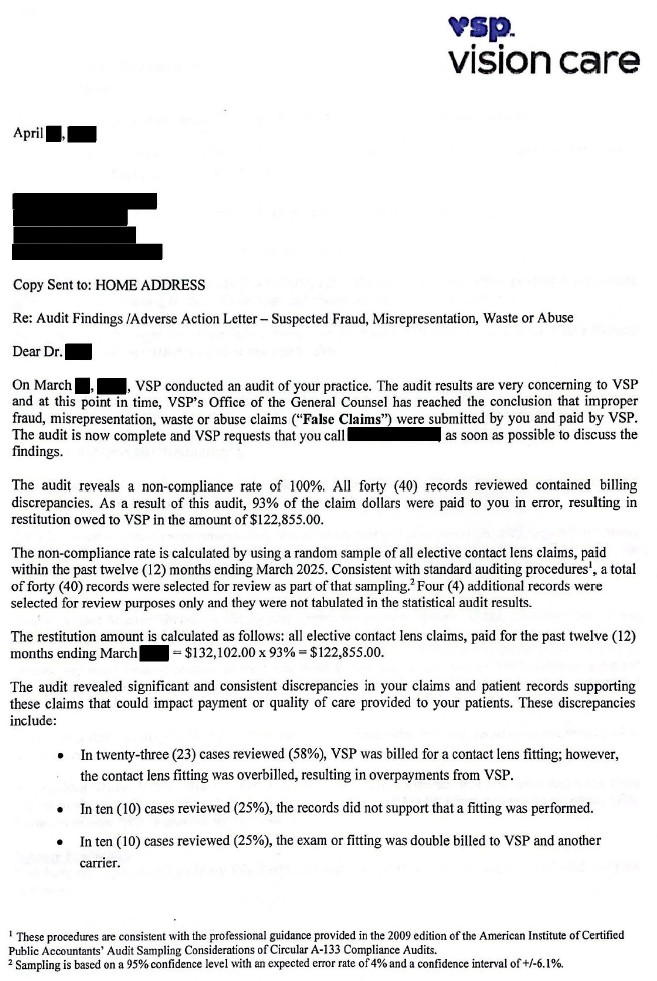
The letter begins:
On March ■, 2025, VSP conducted an audit of your practice. The audit results are very concerning to VSP and at this point in time, VSP's Office of the General Counsel has reached the conclusion that improper fraud, misrepresentation, waste or abuse claims ("False Claims") were submitted by you and paid by VSP. The audit is now complete and VSP requests that you call [the auditor], as soon as possible to discuss the findings.
This is the standard opening paragraph in which VSP accuses the doctor of having submitted "false claims" and committed fraud. It rarely varies, no matter what VSP found in the audit. In this example the auditor is one of VSP's special investigations unit ("SIU") auditors. Generally, the purpose of asking you to call the auditor is so that the auditor can talk to you about her findings and try to obtain information she can use against you if you appeal the audit, and/or to convince you that you should just pay the demand and if you do she'll retract the termination.
The audit reveals a non-compliance rate of 100%. All forty (40) records reviewed contained billing discrepancies. As a result of this audit, 93% of the claim dollars were paid to you in error, resulting in restitution owed to VSP in the amount of $122,855.00.
Normal VSP SIU audits will be of 40 records. In some cases they may perform more than one audit and each will be 40 records (for instance, they may audit 40 "commercial" claims and 40 Medicaid claims as a separate Medicaid-only audit). This second paragraph summarizes the results. In this case VSP determined that there was SOME error in all 40 records and that the doctor was overpaid by 93%, equating to $122,855.00 over the past year.
The non-compliance rate is calculated by using a random sample of all elective contact lens claims, paid within the past twelve (12) months ending March 2025. Consistent with standard auditing procedures1, a total of forty (40) records were selected for review as part of that sampling.2 Four (4) additional records were selected for review purposes only and they were not tabulated in the statistical audit results.
This third paragraph is important because it is the only time VSP will tell you what they were auditing. In this example, "all elective contact lens claims" for the past 12 months. Other common criteria are:
- all elective contact lens claims billed $349.50 and up (or some other price-point cut-off)
- all elective contact lens claims billed with a fitting (CPT 92310) greater than $284.25 (or some other price-point cut-off)
- all elective contact lens claims billed with a contact lens fitting and/or exam CPT code, paid within the past twelve (12) months
- all visually necessary contact lens claims billed with a fitting, paid within the past twelve (12) months
- all essential medical eye care claims, paid within the past twelve (12) months
- all commercial claims with exams paid within the past twelve (12) months
- all In-Office Finishing Claims (VSP IOF Program), paid within the past twelve (12) months
- (when credentialing is the issue) all examination codes billed within the past twelve (12) months
NOTE: The third paragraph tells you what criteria or line of business VSP was auditing. Elective CL? Essential eye care? Visually necessary CL? Whatever it was, the search criteria discloses it. If the search was for "all claims," VSP is looking for doctor credentialing (or for doctors doing exams that are not VSP credentialed). If it is for elective CL claims, or CL claims over a certain dollar amount, they are looking at overbilling (and documentation). If it was for VNCL claims they are looking for eligibility. If it was for Essential Eye Care, they are looking for medical necessity and proper documentation.
Of course, this is not a comprehensive list. But these are actual examples from 2025 and are typical searches VSP does.
The restitution amount is calculated as follows: all elective contact lens claims, paid for the past twelve (12) months ending March 2025 = $132,102.00 x 93% = $122,855.00.
This short sentence shows the total amount you were paid for all records identified from their search criteria ($132,102 in this example) and how that calculates out to the amount VSP is demanding that you repay.
The audit revealed significant and consistent discrepancies in your claims and patient records supporting these claims that could impact payment or quality of care provided to your patients. These discrepancies include:
• In twenty-three (23) cases reviewed (58%), VSP was billed for a contact lens fitting; however, the contact lens fitting was overbilled, resulting in overpayments from VSP.
• In ten (10) cases reviewed (25%), the records did not support that a fitting was performed.
• In ten (10) cases reviewed (25%), the exam or fitting was double billed to VSP and another carrier.
• In six (6) cases reviewed (15%), evidence obtained did not support the documented fittings in the records.
• In four (4) cases reviewed (10%), the patients copays were improperly waived.
• In four (4) cases reviewed (10%), VSP was billed a contact lens fitting fee; however, the contact lens fitting did not meet VSP's documentation standards.
• In two (2) cases reviewed (5%), the patient was overcharged for a copay.
A spreadsheet summarizing the audit findings is enclosed.
This is another key section of the letter because it lists each adverse finding by VSP, in order from most to least common. In this example overbilling for the contact lens fitting was the most common finding (23 audit failures), and fitting documentation accounted for another 16 audit failures.
Each audit will include a summary spreadsheet (see below) which lists each audited patient and some details, with a brief (often not very helpful) description of why the records for this patient were deemed by VSP to have failed the audit.
ADVERSE ACTION LETTER - PAGE TWO
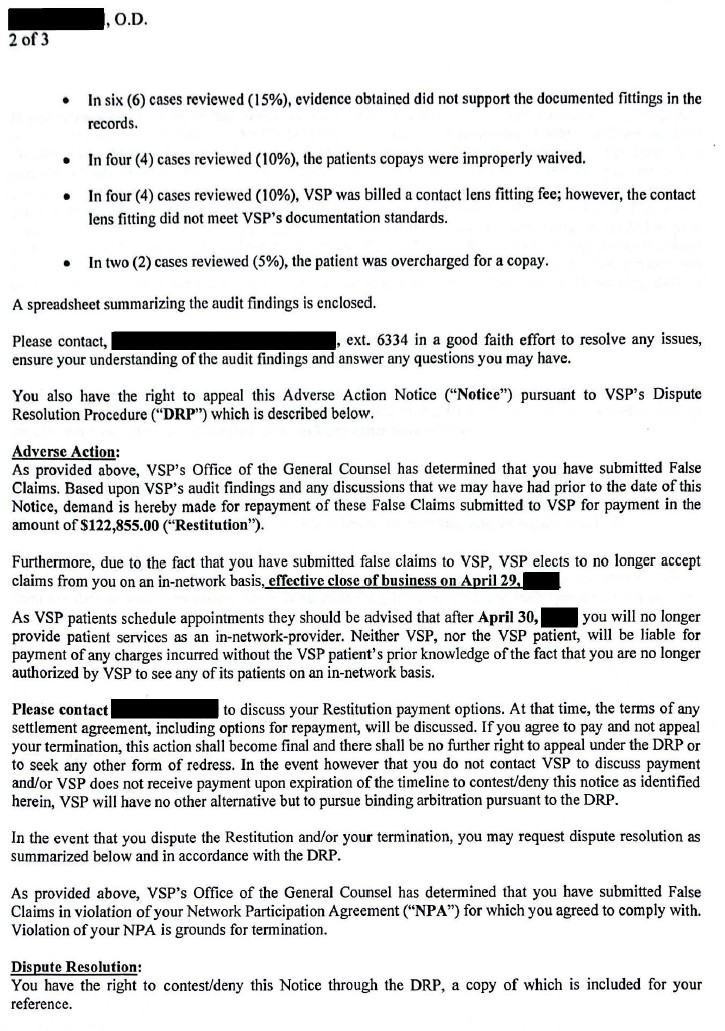
Please contact, [the auditor] at (800) 852-7600, ext. xxxx in a good faith effort to resolve any issues, ensure your understanding of the audit findings and answer any questions you may have.
Once again, VSP asks that you call the auditor (note the self-serving "in a good faith effort" to try and shield themselves from being accused of acting in bad faith) so that she can gather any information from you, such as an admission that you, that you knew of the incorrect billing, etc.
You also have the right to appeal this Adverse Action Notice ("Notice") pursuant to VSP's Dispute Resolution Procedure ("DRP") which is described below.
For the first time VSP advises you, as they are required by law to do, of your right to appeal the Adverse Action Notice.
Adverse Action:
As provided above, VSP's Office of the General Counsel has determined that you have submitted False Claims. Based upon VSP's audit findings and any discussions that we may have had prior to the date of this Notice, demand is hereby made for repayment of these False Claims submitted to VSP for payment in the amount of $122,855.00 ("Restitution").
Furthermore, due to the fact that you have submitted false claims to VSP, VSP elects to no longer accept claims from you on an in-network basis, effective close of business on April 29, 2025.
As VSP patients schedule appointments they should be advised that after April 30, 2025, you will no longer provide patient services as an in-network-provider. Neither VSP, nor the VSP patient, will be liable for payment of any charges incurred without the VSP patient's prior knowledge of the fact that you are no longer authorized by VSP to see any of its patients on an in-network basis.
VSP next section details the "adverse action" VSP is imposing. This is a key paragraph because VSP tells you if you are being terminated from their panel and if so, when the termination takes effect. In this case the doctor was given a week's notice before termination would begin. Typically you'll have about 7-10 working days of notice. This is how much time you have to obtain the help of a knowledgeable lawyer to try and resolve the matter with VSP. Though VSP rules provide that doctors are generally NOT terminated if they appeal (while the appeal is pending), the reality is that VSP ignores its own rules and uses the threat of termination as leverage to force doctors into settling for far more than they often would be legally required to repay. This is why it is essential that you obtain help with the audit BEFORE this termination date. The date can often be extended if the parties are negotiating a settlement.
EXPERT ADVICE: Do NOT ignore this termination date. Your ability to submit claims or log into EyeFinity will end at termination, and once terminated you may even be required to recredential with VSP even if a settlement that reverses the termination is reached. It is essential that you or your legal representative communicate with VSP before the termination date.
In this example, because this was a commercial practice and not a private practice, VSP did not charge for the audit. Typically you will also see this language in the letter: "In addition, you are also being charged $4,434.00 for the cost of this audit." The amount charged will, of course, vary and is often $5,000 or more. That amount will be added to the total restitution VSP is demanding.
In addition, though not in this example, you will find this additional language purporting to bar you from submitting claims on an out-of-network basis or seeing patients on an out-of-network basis:
Effective [Termination Date], VSP will no longer accept electronic claims from you. Paper claims submitted by you for services provided to VSP patients prior to the termination date, may be accepted for a period of up to six (6) months after the termination date in accordance with VSP's policy.
In addition, due to the serious discrepancies noted, VSP will no longer accept claims from you on an out-of-network basis. No claims under any of your tax ID numbers will be accepted, nor will any claims that come from your office location be accepted. This includes, without limitation, situations where benefits are assigned to you by the patient ("AOB"), the submission of claims on behalf of a VSP Member/patient, and/or any general out-of-network claims as an out-of-network provider, directly or indirectly submitted to VSP.
Your name will continue to appear on the Network Doctor list only until the next publication, at which time it will be removed.
As VSP patients schedule appointments they should be advised that you will no longer provide patient services as a VSP Network Doctor, nor will you be able to treat them on an out-of-network basis. Claims for VSP patient services rendered after this date will not be accepted for payment. Neither VSP, nor the VSP patient, will be liable for payment of any charges incurred without the VSP patient's prior knowledge of the fact that you are no longer a VSP Network Doctor.
VSP can refuse to process out-of-network ("OON") claims that come from your office and/or that request payment be made directly to your office. Even though VSP's letter says otherwise, as a general rule VSP cannot refuse to process and pay OON claims submitted by your patient where the money is paid to the patient. Patient's are free to see any licensed eye care provider they choose and if it is OON VSP must pay the patient the OON benefits. And, of course, VSP cannot deny you the right to charge a patient and collect from the patient. VSP is giving you inaccurate or misleading information here in order to further intimidate doctors.
COMMENT: If a patient wants to see you for eye care the patient can see you for eye care. If it is medical, you can bill the patient's medical insurance. If you are terminated from the VSP panel and no longer contracted with VSP as an in-network doctor, in all instances, you can see any patient, whether they have VSP or not, and you are free to charge the patient and collect your fees from the patient. You need not ever mention VSP to the patient. VSP cannot enforce a demand that you inform patients that you are no longer a VSP Network Doctor. That is their job, not yours.
Please contact [the auditor] to discuss your Restitution payment options. At that time, the terms of any settlement agreement, including options for repayment, will be discussed. If you agree to pay and not appeal your termination, this action shall become final and there shall be no further right to appeal under the DRP or to seek any other form of redress. In the event however that you do not contact VSP to discuss payment and/or VSP does not receive payment upon expiration of the time line to contest/deny this notice as identified herein, VSP will have no other alternative but to pursue binding arbitration pursuant to the DRP.
Here VSP again reiterates that they want you to call the auditor, but this time to discuss a "settlement agreement" including how you will repay them -- VSP's number one goal -- and to warn you about giving up your right to appeal -- another goal -- and to threaten you with "binding arbitration."
In the event that you dispute the Restitution and/or your termination, you may request dispute resolution as summarized below and in accordance with the DRP.
As provided above, VSP's Office of the General Counsel has determined that you have submitted False Claims in violation of your Network Participation Agreement ("NPA") for which you agreed to comply with. Violation of your NP A is grounds for termination.
NOTE: In-network private practice doctors have a Network Doctor Agreement ("NDA") whereas commercial providers that "accept" VSP through Costco, Walmart, Target, etc., are technically not "in-network" and they do not sign an NDA. Instead, those doctors sign a Network Participation Agreement ("NPA") or some other document which is similar to, but has differences from, an NDA. (This is why, in the example here, audit fees were not charged -- NDA's have a provision for payment of audit fees whereas NPA's do not.)
ADVERSE ACTION LETTER - PAGE THREE
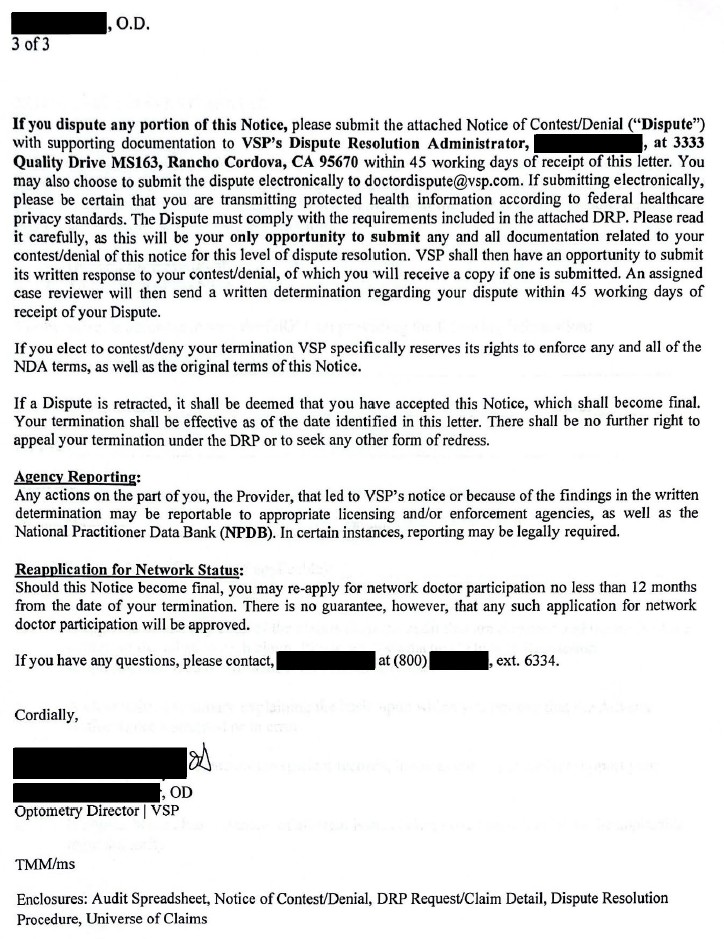
Dispute Resolution:
You have the right to contest/deny this Notice through the DRP, a copy of which is included for your reference.
If you dispute any portion of this Notice, please submit the attached Notice of Contest/Denial ("Dispute") with supporting documentation to VSP's Dispute Resolution Administrator at 3333 Quality Drive MS163, Rancho Cordova, CA 95670 within 45 working days of receipt of this letter. You may also choose to submit the dispute electronically to
If you elect to contest/deny your termination VSP specifically reserves its rights to enforce any and all of the NOA terms, as well as the original terms of this Notice.
If a Dispute is retracted, it shall be deemed that you have accepted this Notice, which shall become final. Your termination shall be effective as of the date identified in this letter. There shall be no further right to appeal your termination under the DRP or to seek any other form of redress.
The letter then provides information about how to initiate a dispute or appeal of the audit. This is important. The law requires that you avail yourself of administrative remedies if there are any, and the VSP dispute resolution process is an administrative remedy. So, if you do not submit an appeal within the 45-working days as required you will lose all right to appeal and cannot take any action in court.
IMPORTANT: The "45 business days" is a hard and fast cut-off for appealing an audit. That is generally about 60 calendar days, but can vary according to holidays, etc. Record the day you receive the notice of adverse action and determine your last day to appeal. Even a poorly made appeal preserves your rights. A poorly made appeal can be cleaned up, but missing the cutoff date cannot be saved. It is advisable to send the email to the email address above AND to the auditor and be sure to save your outgoing email in case there is any dispute.
IMPORTANT: Giving notice of an appeal does NOT automatically stay the termination if VSP's letter says they are terminating you. You must separately ask VSP to stay the termination during your appeal and you need to do that BEFORE the termination date is effective.
Agency Reporting:
Any actions on the part of you, the Provider, that led to VSP's notice or because of the findings in the written determination may be reportable to appropriate licensing and/or enforcement agencies, as well as the National Practitioner Data Bank (NPDB). In certain instances, reporting may be legally required.
VSP is a mandatory reporter, meaning that if they terminate you from their panel (i.e., terminate your NDA) they are required to report that termination to the NPDB. That, in turn, is reported to other payers and to your state Board. VSP does not report to the NPDB if your NDA/NPA is not terminated. This becomes a strong incentive to either settle with VSP or appeal the termination.
Reapplication for Network Status:
Should this Notice become final, you may re-apply for network doctor participation no less than 12 months from the date of your termination. There is no guarantee, however, that any such application for network doctor participation will be approved.
VSP likes to throw this in for good measure, to create a further incentive for you to agree to pay them and not appeal in order to avoid being terminated.
ADVERSE ACTION LETTER - SUMMARY SPREADSHEET
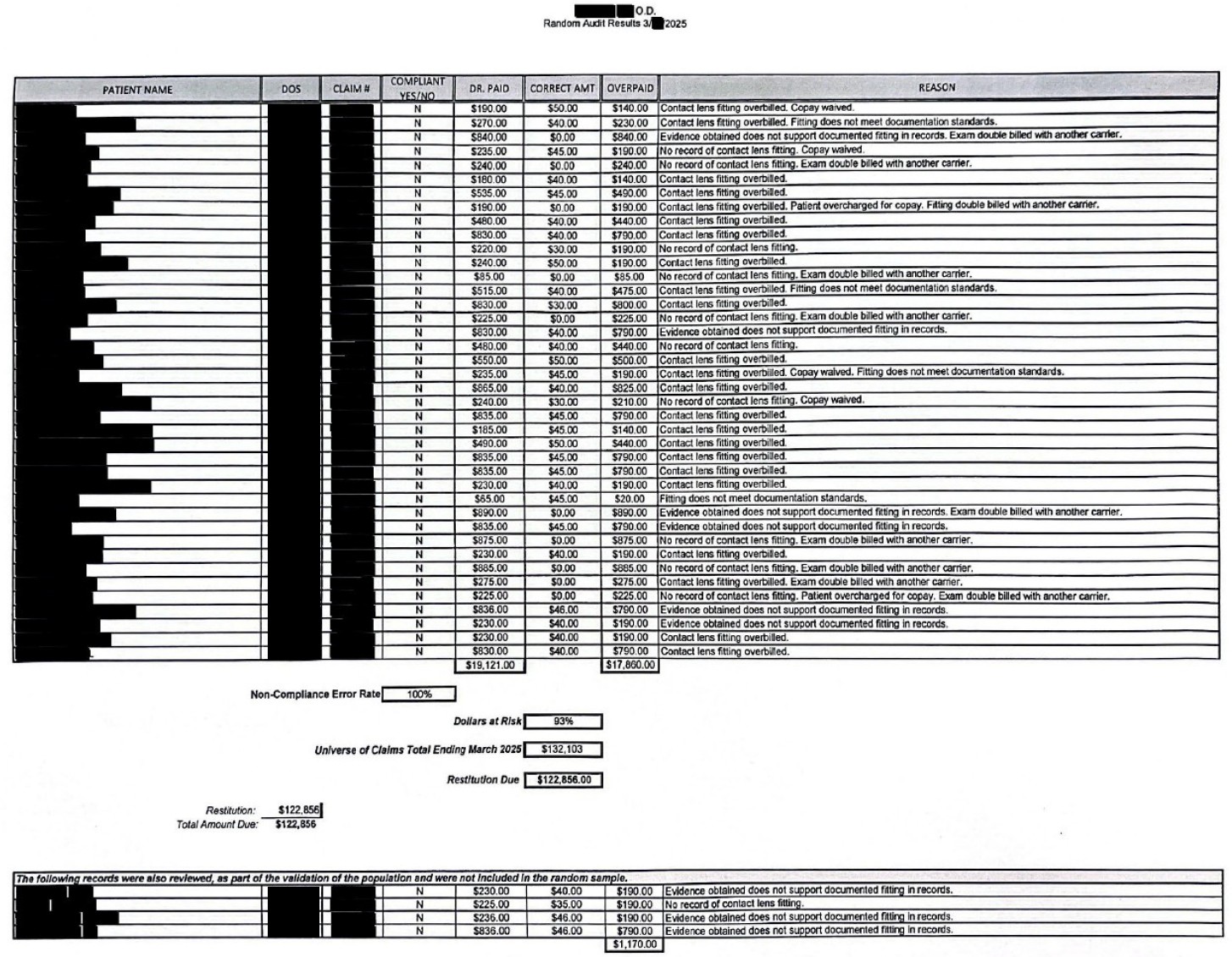
Finally, along with the multi-page dispute resolution process, VSP provides a short summary spreadsheet of the audit findings showing the results of the audit for each patient and how the restitution was calculated.
The spreadsheet shows for each patient what you were paid, what VSP says you should have been paid, and the amount you were overpaid. VSP assumes that anything billed incorrectly, except for exams, "should" be paid $0.00. So if you billed $200 and VSP says your usual and customary is $100, in VSP's view you should be paid $0.00 (not $100, which is what anyone else would say). There are three important aspects to this spreadsheet.
- First, it shows you the "dollar ratio," how much restitution you must pay for each dollars of alleged over-payment found in the audit. In this example the over-payment of $17,860 results in restitution of $122,856. That's a ratio of just under $7. So for each $100 of over-payment the restitution is about $700. In some cases the ratio can be $30 or more. This is helpful to know so that attention is paid in challenging the claims with the biggest impact.
- Second, it shows you any claims that passed the audit. These can then be set aside.
- Third, it shows you why any particular claim was denied so you can focus your appeal on the correct issue(s).
Cordially,
/s/ signature
[Director], OD
Optometry Director I VSP
Except in the cases involving clinical issues (such as medical necessity), my experience is that the optometry director has little or nothing to do with the audit or the audit letter whatsoever. Her name is a rubber-stamp placed there by the auditor. And even in those cases where she does actually have some role in the audit, she is still a rubber stamp for the auditor. The point is, don't expect the Optometry Director to come to your rescue. She is 100% on the side of VSP and will stretch plausibility to its limits to do so.
The take-home here is that, with experienced counsel, a lot of information can be learned from the adverse action notice and that begins the process of addressing the audit findings. If you have received one of these letters please review the VSP FAQ and the information on this website.